 Find Our Showroom


All of our quality products are available at very competitive prices
All of our quality products are available at very competitive prices
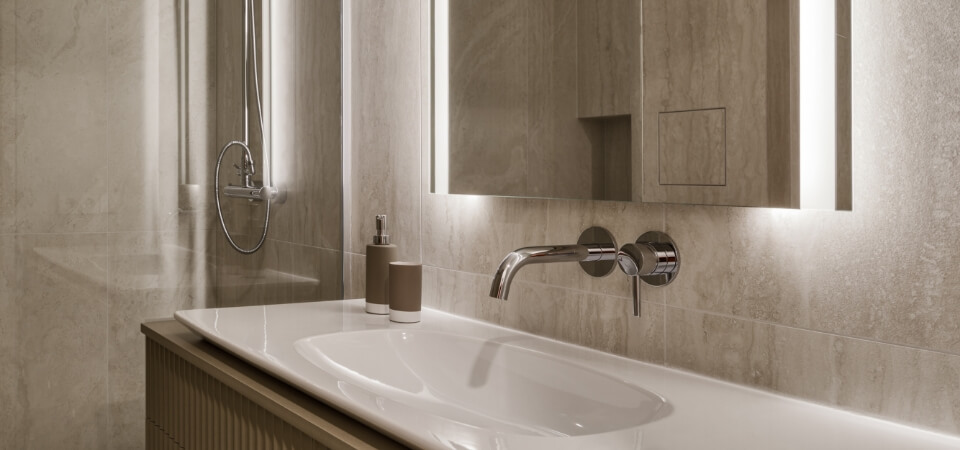
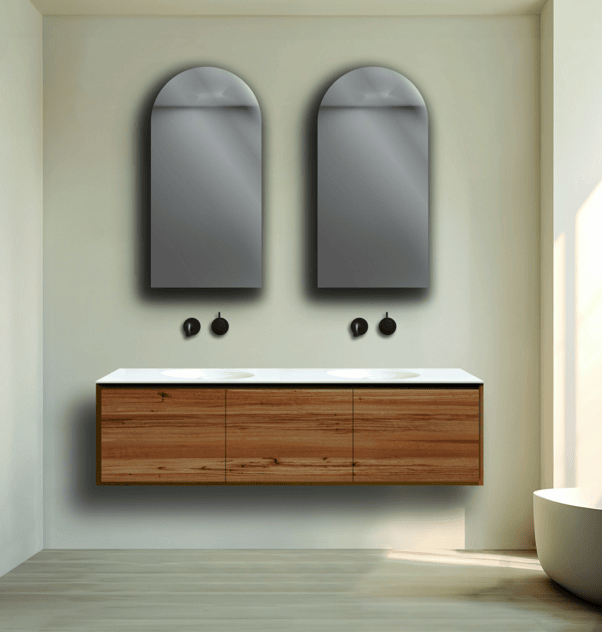
Walk into any bathroom after a hot shower and you feel what the vanity has to live with: warm, wet air that lingers for hours. In a humid Australian bathroom, that daily steam wears a vanity down more than the label on the material ever will. No single material wins outright.
What decides the outcome is how the piece is built. Water looks for the weak point first: a bare cut edge, an unsealed join, a thin patch of finish. Once it gets in, a standard board carcass swells at the edges and loses its grip on screws and hinges. Seal those edges, sit the cabinet on a moisture-resistant carcass, and finish every surface properly, and the same water rolls off instead of soaking in.
Timber, stone, laminate and solid surface all earn a fair place in a wet area, and all can fail early when the build is cut short. Judge each against one standard: sealed edges, a moisture-resistant carcass and a consistent quality finish.
Timber earns its spot for one reason no other material matches: natural wood warmth, with grain, colour and character that stone and laminate only imitate. The catch is that timber is the one family that moves, so it only holds up in a bathroom when it is sealed properly.
Bare wood is the real problem, not the species. Left raw, timber drinks up steam and splashes, then swells, cups, greys and stains where water sits. A full polyurethane finish and sealed edges keep that moisture on the surface. Skip the finish on an edge or a join, and that’s exactly where the first swelling and staining show up.
To ensure your Timber vanity is not affected by the bathroom environment, Mode vanities use Timber Veneer which is real timber sliced finely and pressed onto a highly moisture resistant board and then sprayed with 2 coats of clear polyurethane . This is the most cost effective and sustainable way to incorporate real wood into your bathroom design.
Timber Veneer is 100% natural and so the pattern and grain aren’t altered in any way and each cabinet is unique. It is also more environmentally friendly using less of a precious resource. In contrast to solid timber, Timber Veneer will not expand and contract due to the variations in temperature or humidity in a bathroom environment.
A Caesar stone bench top earns its premium where it counts: the surface where a basin and taps sit. Caesarstone features superior stain, scratch and heat resistance compared to softer surfaces, and gives a bathroom a genuine premium look.
There’s one rule Australian buyers now need before shopping for a stone look. Since 1 July 2024, Australia has prohibited the manufacture, supply, processing and installation of engineered (reconstituted) stone benchtops which contain silica.
Caesarstone is 100% silica free and is at the forefront of technical innovation and contemporary surface design.
Stone is worth its price when you want maximum hardness and a premium finish, and the current path to it is natural, porcelain or another silica-free surface rather than the old reconstituted product.
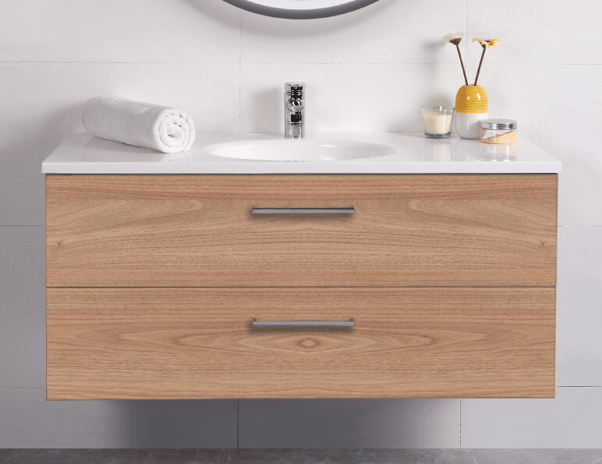
A Melamine woodgrain look cabinet carries a dated, budget reputation, but modern decorative doors & panels have moved well past the plastic look of decades ago. The modern Woodgrain finishes look more realistic and wipe clean easilyholding up well against daily use.
Its lifespan is decided at the edges, not the face. Modern woodgrain melamine is a hard-wearing skin bonded to a board substrate, and water rarely attacks the skin. It gets in at the edges and joins, reaches the board underneath, and that’s where swelling and peeling start. Once the substrate swells, the melamine lifts and the damage can’t be reversed.
Two build details separate a melamine vanity that lasts from one that fails within a couple of years: every edge needs proper sealing so water can’t reach the core, and the substrate should be a moisture-resistant board rather than standard board. Get those two right, and a melamine cabinet can genuinely go the distance in a bathroom.
Corian Solid surface is a man-made material of acrylic resin blended with mineral fillers, and is non-porous and it resists stains without needing to be sealed.
Two features make it especially bathroom-friendly. Sheets meet in a seamless join that hides where two pieces come together, and the material can be formed with an integrated basin, so there’s no rim or silicone line for grime to collect in. If the surface picks up a scratch or a scorch, a fabricator can sand the mark out and bring the finish back.
The trade-off is hardness. A solid surface sits below Caesarstone on heat and scratch resistance, so a dropped heavy object or a very hot styling tool can mark it more easily than Caesarstone. For a low-maintenance, seamless, hygienic vanity bench top, it’s hard to beat.
Here’s the part most material guides skip: in a wet area, the cabinet usually fails before the top does. A stone or solid-surface top shrugs off water for decades, but the vanity cabinet carcass underneath is where moisture does its quiet damage.
Standard board is the weak link. Ordinary MDF and particleboard absorb moisture, then swell at the edges, break down at the surface and lose their grip on screws and hinges. Moisture-resistant MDF, often labelled HMR MDF, is made with additives that slow water absorption, and it holds its shape far better in a damp room.
The board is only half the story. Edge banding seals the exposed edges, and a polyurethane finish coats the faces, so water stays on the outside. Where the edge banding lifts or the finish wears thin, raw board is exposed and the swelling begins there first. Whatever surface sits on top, a moisture-resistant carcass with sealed edges decides how long the vanity lasts.
The material sets the look. These build details decide whether it lasts, whether you pick timber, stone, laminate or solid surface:
Sealed edges, moisture-resistant construction and made-to-order sizing tend to travel together, since a maker building to order can control both the edge work and the carcass that decide longevity. You don’t need a badge or certification to spot quality; check the edges, the carcass, the finish and the warranty.
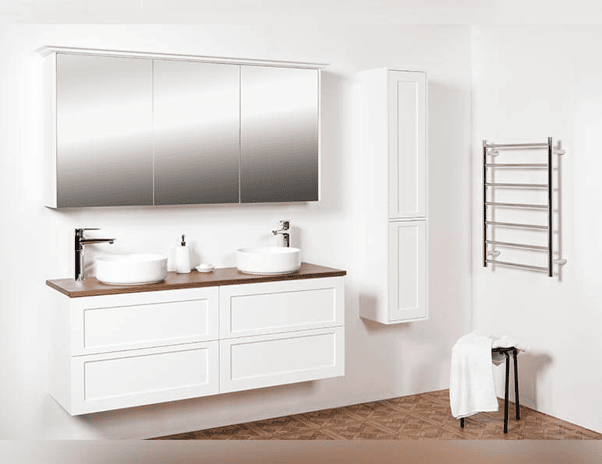
Upfront price is only the first number. Over ten years, upkeep, repairs and lifespan change which material was actually the cheapest. Here’s how the four families compare, using relative bands rather than dollar figures, since price depends on size and finish:
| Material | Upfront cost | Ongoing upkeep | Lifespan in a wet area |
| Sealed timber veneer cabinet | high | Minimal | Long when maintained |
| Caesarstone bench top | high | Low – lifetime warranty – superior stain , scratch & heat resistance | Longest |
| Melamine Cabinet | Mid | Low day to day | Shorter if edges fail, long if they hold |
| Solid surface bench top | Mid – high | Medium – softer and less heat resistant than Caesarstone | Long |
Match the material to how your bathroom is actually used, then hold every option to the same build standard.
For a busy family bathroom with heavy daily use and plenty of humidity, lead with a hard, low-fuss top: Caesarstone or solid surface, on a moisture-resistant carcass. For a tight budget, sealed-edge laminate on a moisture-resistant substrate gives the most bathroom for the money. For a warm, natural look in an ensuite or feature bathroom, sealed timber veneer in a hardwood like Tasmanian oak rewards you, provided the finish is kept up.
Every one of these comes back to the same three things: sealed edges, a moisture-resistant carcass and a consistent finish. Pick the surface that suits your style and budget, then make the build quality non-negotiable.
There’s no single best material. Timber veneer, Caesarstone, melamine and solid surface can all last in a humid bathroom, and each can fail early if built poorly. What decides longevity is the build: fully sealed edges, a moisture-resistant carcass and a consistent quality finish.
Yes, as long as the timber is sealed. Bare wood swells, stains and greys when it soaks up steam and splashes. Real timber veneer applied to highly moisture resistant board and sealed with a polyurethane finish with sealed edges is essential.
Swelling and peeling almost always start at the edges, where water reaches the board inside the cabinet or top. Seal every edge and join so water can’t get in, and build on a moisture-resistant carcass or substrate rather than standard board.
Yes. A vanity rarely fails across its flat, finished face; it fails where a raw edge or join lets water into the board, which then swells and lifts the surface. Sealing every edge is what keeps moisture on the outside.
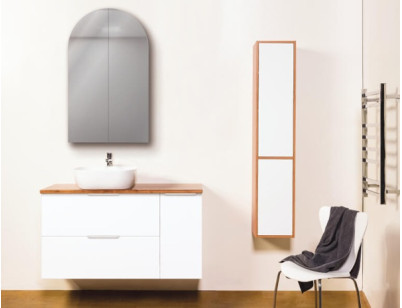
Choosing the right bathroom vanity for your home often comes down to how it looks in the showroom and how you imagine it will look in your home. However, the material that it is made of is just as important as how it looks. This piece of furniture will be in a high-traffic area and […]
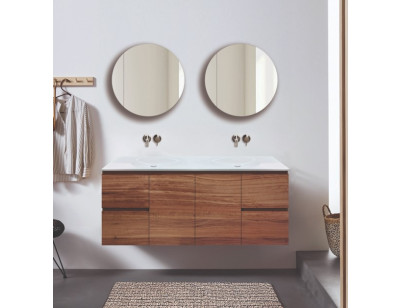
Choose a wall-hung vanity when floor space and a light, open look lead, as in a small bathroom or ensuite with in-wall plumbing. Choose freestanding when storage, a tighter budget or existing floor plumbing lead. Wall-hung needs solid blocking behind the wall; freestanding hides the pipes and usually costs less to fit. Wall-Hung vs Freestanding: […]
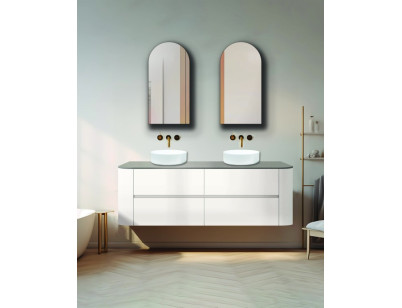
Getting bathroom vanity sizes right in Australia comes down to more than the wall length, it’s decided by depth, door clearance and plumbing set-out too. Which of the six standard vanity widths fits your bathroom? Width is where nearly everyone starts when working out bathroom vanity sizes, because it has to fit the wall. It’s […]
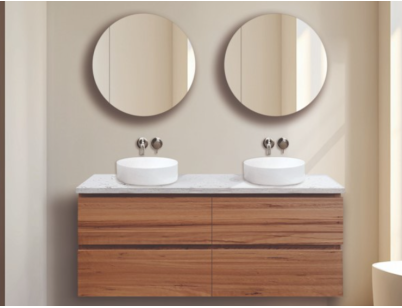
A vanity sets the tone for the whole bathroom. It is the centrepiece, the talking point, and the first thing people notice when they enter your bathroom. Sometimes off-the-shelf options don’t fit into awkward corners or non-standard bathroom shapes, or ensuites which have been squeezed between bedrooms and wardrobes. This is where custom made vanity […]